2012-12-07 Fri
■ #1320. LAEME で見る most の異形態の分布 [vowel][superlative][map][laeme][me_dialect][comparison]
[2012-11-24-1]の記事「#1307. most と mest」で取り上げた中英語の最上級 most の異形態について,初期中英語における母音別の分布を LAEME を用いて調査した.地図上に位置づけられるテキストから取り出した most の異形態は全部で249例あり,これを語幹母音に従って分別したものを HelMapperUK に流し込んだ.読み込ませたデータファイルはこちら.マークの大きさは頻度に比例する.
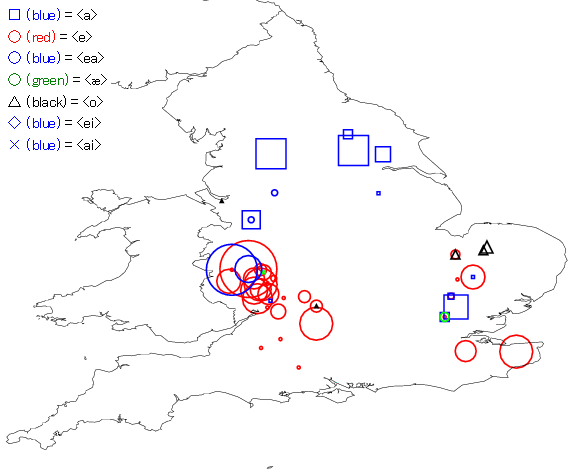
<mast> など <a> を示すものは主として北部に分布し,<mest>, <meast>,
2012-11-24 Sat
■ #1307. most と mest [analogy][superlative][vowel][me_dialect][corpus][hc][ppcme2][comparison]
中英語には,最上級 most が mest という前舌母音字を伴って現われることが少なくない.近代英語以降,後者は廃れていったが,両形の起源と分岐はどこにあるのだろうか.
most は Proto-Germanic *maistaz に遡ることができ,ゲルマン諸語では Du. meest, G meist, ON mestr, Goth. maists などで文証される.音韻規則に従えば,古英語形は māst となるはずであり,実際にこの形態は Northumbrian 方言で確認されるものの,南部方言では確認されない.南部では,前舌母音を伴う West-Saxon mǣst や Kentish mēst が用いられた.OED によれば,前舌母音形は,lǣst "least" との類推とされる.この前舌母音の系統が,主として mest(e) という形態で中英語の南部方言へも継承され,そこでは15世紀まで使われた.
一方,北部方言に起源をもつ形態は,中英語では後舌母音の系統を発達させ,主として most(e) という形態が多用された.じきに中部,南部でも一般化したが,北部方言形の南下というこの時期の一般的な趨勢に加え,比較級 mo, more の母音との類推も一役買ったのではないかと想像される.
結果的に,近代英語以降にはゲルマン祖語からの規則的な発達形 most が標準的となってゆき,古英語から中英語にかけて用いられた mest は標準からは失われていった.「一番先の」を意味する中英語 formest (cf. 比較級 former) が,15世紀に foremost として再分析された背景には,上述の most による mest の置換が関与しているかもしれない.もっとも,古英語より,最上級語尾の -est 自体が -ost とよく混同されたのであり,最上級に関わる形態論において,両母音の交替は常にあり得たことなのかもしれない.
なお,PPCME2 でざっと後舌母音系統 (ex. most) と前舌母音系統 (ex. mest) の分布を調べてみると,前者が354例,後者が168例ヒットした.Helsinki Corpus でも簡単に調査したが,中英語でも現代標準英語と同様に most 系統が主流だったことは間違いないようだ.
2012-05-08 Tue
■ #1107. farther and further [comparison][superlative][etymology][i-mutation][suppletion]
規範文法によれば,副詞・形容詞 far の比較級(および最上級)には標題のとおり2種類があり,用法の区別が説かれる.Usage and Abusage より,その区別をみてみよう.
farther, farthest; further, furthest. 'Thus far and no farther' is a quotation-become-formula; it is invariable. A rough distinction is this: farther, farthest, are applied to distance and nothing else; further, furthest, either to distance or to addition ('a further question').
規範文法ではなく記述文法でいえば,口語や特に BrE では farther, farthest は廃れる傾向にあり,用法の区別も失われてきているという.
用法の区別の前提となっているのが形態の区別だが,そもそもなぜ2つの異なる形態が生じたのだろうか.far の比較級,最上級の形態については,2つの問題がある.1つは,なぜ原級には含まれない th が挿入されているのか,もう1つは,なぜ第1母音(字)の異形として u が現われたのか.
far の古英語の形態は feor(r) だった.さらに語源を遡れば,「#68. first は何の最上級か」 ([2009-07-05-1]) および「#695. 語根 fer」 ([2011-03-23-1]) で見たように,印欧語根 *per にたどりつく.古英語での比較級,最上級はウムラウト (i-mutation) 母音を示す fierr, fi(e)rrest だったが,これは12世紀以後には廃れた.代わって,原級の母音を反映した類推形 ferrer, farrer また ferrest, farrest が勢力を得て,17世紀頃まで用いられた.
さて,古英語には,究極的な語源こそ同じ *per に遡るが,独立して発達してきた forþ "forth" という語があった.この比較級が furþor という形態だった."far" の比較級としての fierr と "forth" の比較級としての furþor は,意味の上では「さらに先(の),さらに遠く(の)」と類似しているので,形態的に混同が生じた.そうして,"far" の系列に非語源的な th が挿入され,"forth" の系列に非語源的な母音 e が侵入した.中英語では ferther などの形態が広く行なわれたが,近代英語の17世紀以後は,母音変化を経て生じた farther の形態が標準化された.これと平行して,混同以前の語形を伝える最も語源的といってよい further も存続した.こうして,farther と further が,ともに far の比較級と解釈されつつ生き残ってきたのである.最上級の形態も,同様に説明される.
近代以後,両者の並立を支えてきたのは規範文法に基づく用法の区別であると推測されるが,用法の区別それ自体にある程度の歴史的な根拠のあることが,上述の語史からわかる.母音に注目すれば,farther は far の比較級であり,further は forth の比較級であるから,前者が物理的距離の意味に,後者が比喩的な順番などの意味に対応するのは理解しやすい.
・ Partridge, Eric. Usage and Abusage. 3rd ed. Rev. Janet Whitcut. London: Penguin Books, 1999.
2011-05-05 Thu
■ #738. inclusive superlative [superlative][contamination][syntax][corpus][ppceme]
昨日の記事「構文の contamination」 ([2011-05-04-1]) で最後に取り上げた "inclusive superlative" について,BNCweb でどのくらいヒットするか試してみた."(most _AJ0 | _AJS) (_{N})* of (any)? other" で検索すると,以下の7例を取り出すことができた(赤字は引用者).
- Chang's speed was the best of any other player.
- Perhaps the most notable of other attempts to describe parents in this fashion was undertaken by Earl S. Schaefer.
- This percentage is the largest of any other constituency in England.
- But centuries of migration, conquest, occupation, intermarriage, trade and cultural exchange - not to mention the tendency of artists to copy or reinterpret the most successful facets of other artists' work - have eroded much of this exclusivity.
- Commander Keen has the largest fan club of any other shareware game available.
- 'In proportion to the kiwi's size the egg is the largest of any other bird.
- I say in particular our union because everyone here knows we probably have the largest and best training programme of any other union in Britain today.
初期近代英語にも見られたということなので,The Penn-Helsinki Parsed Corpus of Early Modern English (PPCEME) でざっと調べてみると,John Fryer (b. c1650, d. 1733) なる人物の東洋旅行記に次の1例があった.
They yet retain a Warlike Disposition, being still accounted the best Gunners here of any other places in Persia;
この妙な構文の起源と歴史を探るには,混交のもととなっている2つの構文 comparative + than any other と superlative + of all の頻度や文脈をまず洗い出す必要があるだろう.
2011-05-04 Wed
■ #737. 構文の contamination [blend][contamination][syntax][superlative][bnc][corpus]
[2011-01-17-1]で blend 「混成語」を話題にした際に少々触れたが,類似した過程に contamination 「混交」がある.両者は意識的か否かという観点か区別されることがあるが,特に区別せず同様に用いられることもある.通常は語形成上の過程として捉えられるが,[2011-01-17-1]の記事で触れたように構文のレベルででも起こりうる.例えば,前の記事では,"Why did you do that for?" や "different than" を挙げた.
Graddol を講読中に構文の contamination に出会った(赤字は引用者).
English is remarkable for its diversity, its propensity to change and be changed. This has resulted in both a variety of forms of English, but also a diversity of cultural contexts within which English is used in daily life. (5)
ここでは,both . . . and . . . と not only . . . but also . . . の構文が混交している.BNCweb より検索キーワード "both +** but also" で類例を探してみると,6例ほどが見つかった(赤字は引用者).
- Ion Pacepa, Ceausescu's chief intelligence officer who defected in 1978, takes particular pleasure in his memoirs in exposing Stefan Andrei as both corrupt but also as well aware of the absurdity of the Ceausescus' pretensions, especially Elena's academic titles.
- Their economy and population were both suffering, but also they were becoming wary of the Dzhungars' increasing strength.
- In fitting statistical models to study relationships, it is important to take account of such hierarchies, both for technical reasons but also because influential factors can be present at any or all levels of aggregation.
- The changes that have been introduced into South Africa [pause] forced upon the white minority government by both international pressure but also by the magnificent work at the A N C in Cosatu [pause] must be supported as well but we cannot treat South Africa as anything but a pariah [pause] a, a, a national pariah [pause] until we see one person one vote, and a black majority government in South Africa.
- 'Committees' means both actual committees but also individuals or organisers listed as committees.
- I mean that can be both pleasurable, but also make somebody feel uncomfortable.
contamination は,共時的には話者の発話時に生じる2つの関連構文の混交として解釈されるが,これが共同体に広がってある程度の認知度を得ると,新しい構文として独立し定着することがある.そのような場合には,contamination は通時的な観点からアプローチすることができるだろう.以下は現代英語に見られる構文の contamination の例だが,これらがいつ頃に現われ,現在までにどの程度の認知度を得てきたかという問題は,英語史の問題である.
(1) these kinds of things: these things と this kind of things の混交.
(2) different than: different from と other than の混交.
(3) different to: different from と opposed to の混交.similar to との類推とも考えられる.
(4) cannot help but do: cannot help doing と cannot but do の混交.
(5) It is no good for us complaining about it.: It is no good for us to complain about it. と It is no good we complaining about it. の混交.
(6) no sooner . . . when: no sooner . . . than と scarcely . . . when の混交.
(7) I am friends with him.: I am friendly with him. と He and I are friends. の混交.
(8) a man whom she thought was a murderer: a man who she thought was a murderer と a man whom she thought to be a murderer の混交.
(9) the cleverest of all the other boys: cleverer than the other boys と the cleverest of all the boys の混交.
調べてみるといろいろとあるようだが,(9) のような例は少なくないようで,石橋 (127) は次のようにコメントしている.研究材料としておもしろそうだ.
Sunday's action was the most brilliant and fruitful of any fought up to that date by the fighters of the Royal Air Force. [the most . . . of (all) + (more . . . than) any]---W. Churchill / This is the greatest error of all the rest. [the greatest . . . of (all) + (a greater . . . than) all the rest]---Sh., Mids. N. D. v. i. 250. 最後の例のように,最上級に修飾される名詞を,意味上はそれを含まないはずの「その他」の中に包括させた混交表現を,とくに包括最上級 (Inclusive superlative) と呼ぶことがある.その例は近代初期の英語にときどき見いだされる.
・ Graddol, David. The Future of English? The British Council, 1997. Digital version available at http://www.britishcouncil.org/learning-research-futureofenglish.htm.
・ 石橋 幸太郎 編 『現代英語学辞典』 成美堂,1973年.
2009-07-05 Sun
■ #68. first は何の最上級か [superlative][etymology][numeral][sobokunagimon]
昨日の記事[2009-07-04-1]で,序数詞 first は最上級語尾をもっていることを指摘した.それでは,何の最上級なのか.
fir の部分はゲルマン祖語の *fur- 「前に」に遡り,その意味と形態の痕跡は before, far, fare, for, for-, fore, forth, from などに残る.first の母音は,ウムラウトによる.
したがって,最上級 first の原義は「(時間的に)最も前」すなわち "earliest" ということになる.一方,古英語には "early, before" の意味を表す別の語として ǣr があった.これは現代英語では古風な ere に残っているし,early はそれに -ly 語尾をつけた形に由来する.ǣr の最上級 ǣr(e)st は,現代英語では erstwhile 「昔の,かつての」という語のなかに生き残っている.
Powered by WinChalow1.0rc4 based on chalow