昨日の記事「#6118. salmon の l はなぜ発音されないのですか? --- mond の質問」 ([2026-01-26-1]) では,salmon (鮭)の黙字 l の背景にある語源的綴字 (etymological_respelling) の問題を取り上げました.今回は,その関連で,よく似た経緯をたどりながらも現代では異なる結果となっている falcon (ハヤブサ)について話しをしましょう.
falcon も salmon と同様,ラテン語 (falcōnem) に由来し,古フランス語 (faucon) の諸形態を経て中英語に入ってきました.したがって,当初は英語でも l の文字も発音もありませんでした.ところが,16世紀にラテン語綴字を参照して <l> の綴字が人為的に挿入されました.ここまでは salmon とまったく同じ道筋です.
しかし,現代英語の標準的な発音において,salmon の <l> が黙字であるのに対し,falcon の l は /ˈfælkən/ や /ˈfɔːlkən/ のように,綴字通りに /l/ と発音されるのが普通です.これは,綴字の発音が引力となって発音そのものを変化させた事例となります.
ところが,事態はそう単純ではありません.現代の発音実態を詳しく調べてみると,興味深い事実が浮かび上がってきます.LPD3 に掲載されている,英米の一般話者を対象とした Preference Poll の結果を見てみましょう.
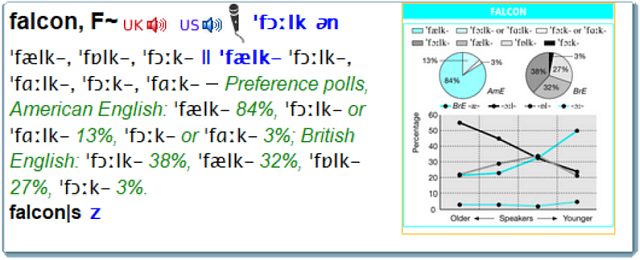
圧倒的多数が /l/ を発音していますが,英米ともに3%ほどの話者は,現在でも /l/ を響かせない /ˈfɔːkən/ などの古いタイプの発音を使用していることが確認されます.この場合の <l> は黙字となります.さらに興味深いのは,CEPD17 の記述です.この辞書には,特定のコミュニティにおける慣用についての注釈があります.
Note: /ˈfɔː-/ is the usual British pronunciation among people who practise the sport of falconry, with /ˈfɔː-/ and /ˈfɔːl-/ most usual among them in the US.
鷹匠の間では,イギリスでは /l/ を発音しない形が普通であり,アメリカでもその傾向が見られるというのです.専門家の間では,数世紀前の伝統的な発音が「業界用語」のように化石化して残っているというのは興味深い現象です.
では,歴史的に見てこの <l> の綴字はいつ頃定着したのでしょうか.Hotta and Iyeiri では,EEBO corpus (Early English Books Online) を用いて,初期近代英語期における falcon の綴字変異を詳細に調査しました.その調査によれば,単数形・複数形を含めて,以下のような37通りもの異形が確認されました (147) .<l> の有無に注目してご覧ください.
falcon, falcons, faulcon, faucon, fawcons, faucons, fawcon, faulcons, falkon, falcone, faukon, faulcone, faukons, falkons, faulcones, faulkon, faulkons, falcones, faulken, fawlcon, fawkon, faucoun, fauken, fawcoun, fawken, falken, fawkons, fawlkon, falcoun, faucone, faulcens, faulkens, faulkone, fawcones, fawkone, fawlcons, fawlkons
まさに百花繚乱の様相ですが,時系列で分析すると明確な傾向が見えてきます.論文では次のようにまとめています (152) .
FALCON is one of the most helpful items for us in that it occurs frequently enough both in non-etymological spellings without <l> and etymological spellings with <l>. The critical point in time for the item was apparently the middle of the sixteenth century. Until the 1550s and 1560s, the non-etymological type (e.g., <faucon> and <fawcon>) was by far the more common form, whereas in the following decades the etymological type (e.g., <faulcon> and <falcon>) displaced its non-etymological counterpart so quickly that it would be the only spelling in effect at the end of the century.
つまり,16世紀半ば(1550年代~1560年代)が転換点でした.それまでは faucon のような伝統的な綴字が優勢でしたが,その後,急速に falcon などの語源的綴字が取って代わり,世紀末にはほぼ完全に置き換わったのです.
salmon と falcon.同じ時期に同じような動機で l が挿入されながら,一方は黙字となり,他方は(専門家を除けば,ほぼ)発音されるようになった.英語の歴史は,こうした予測不可能な個々の単語のドラマに満ちています.
falcon について触れている他の記事もご参照ください.
・ 「#192. etymological respelling (2)」 ([2009-11-05-1])
・ 「#488. 発音の揺れを示す語の一覧」 ([2010-08-28-1])
・ 「#2099. fault の l」 ([2015-01-25-1])
・ 「#5981. 苅部恒徳(編著)『英語固有名詞語源小辞典』(研究社,2011年)」 ([2025-09-11-1])
・ Wells, J C. ed. Longman Pronunciation Dictionary. 3rd ed. Harlow: Pearson Education, 2008.
・ Roach, Peter, James Hartman, and Jane Setter, eds. Cambridge English Pronouncing Dictionary. 17th ed. Cambridge: CUP, 2006.
・ Hotta, Ryuichi and Iyeiri Yoko. "The Taking Off and Catching On of Etymological Spellings in Early Modern English: Evidence from the EEBO Corpus." Chapter 8 of English Historical Linguistics: Historical English in Contact. Ed. Bettelou Los, Chris Cummins, Lisa Gotthard, Alpo Honkapohja, and Benjamin Molineaux. Amsterdam: Benjamins, 2022. 143--63.