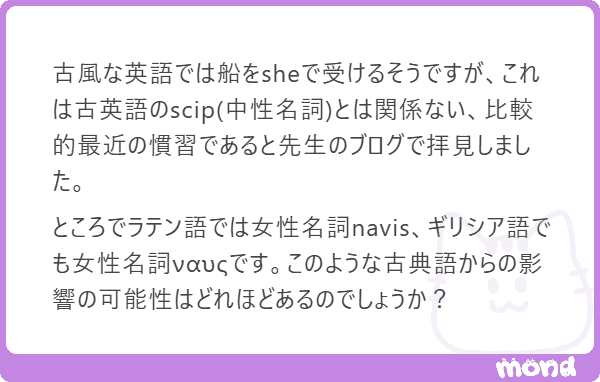
一昨日,知識共有プラットフォーム mond にて,古風な英語で船を she で受ける慣習に関する質問に回答しました.一般に,英語における船や国名,抽象名詞の擬人化は,中英語期にフランス語やラテン語の文法性(およびそれに付随する文学的伝統)の影響を受けて定着したものと考えられます.古英語の文法性が直接継承されたわけではなく,一度文法性が崩壊した後に,外来の修辞的慣習として再構築された「後付けの性」であるという解釈です.
回答では,国名がラテン語の -ia 語尾(女性名詞)の影響で女性化しやすかったことなどに触れましたが,一方で,中英語の擬人的性付与の実態はそれほど単純ではなかったことにも言及しました.「国名や抽象名詞に女性性を与えるケースは確かに目立ちますが,男性性が付与される例も散見されます」と述べたとおりです.
この主張の根拠として,Mustanoja (51) の記述があります."Trend Towards Masculine Gender" と題する節で,中英語にみられる不思議な現象が紹介されています.以下にフルで引用します.
TREND TOWARDS MASCULINE GENDER. --- A feature which seems to be peculiar to the ME development is a tendency of nouns to assume the masculine gender. Not very much is known about this phenomenon, except that it seems to be at work in a large number of ME nouns, native or borrowed from other languages, with concrete or abstract meanings, which tend to assume the masculine gender without any apparent reason and often in contrast to the gender of the corresponding nouns in Latin and French. The fact, for example, that earth (OE feminine) is usually treated as a masculine in ME has been assigned to this peculiar trend towards the masculine gender. This trend has also been thought to account for the occasional use of nature and youth (OE geoguþ, fem.) as masculines. As pointed out above (p. 48), church is often feminine in ME; its occasional use as a masculine noun has also been ascribed to the general tendency of nouns towards the masculine gender. Geographical names are normally neuter, but Robert of Gloucester occasionally treats them as masculines: --- Engelond his a wel god lond; . . . þe see geþ him al aboute, he stond as in an yle (3); --- þe Deneis vor wraþþe þo asailede vaste þen toun and wonne him (RGlouc. 6050; a number of MSS read þe toun and hit). Examples of this kind could be multiplied many times over. It is possible that in several cases of this kind the masculine gender will be satisfactorily explained in some other way when enough evidence has accumulated to clarify its development; yet even if this should happen it can hardly be denied that a tendency towards the masculine gender exists in ME.
Mustanoja によれば,中英語には名詞を男性名詞として扱う独自の傾向があったということです.この現象の詳細はあまり解明されていないようですが,本来語か借用語か,あるいは具体的意味か抽象的意味かに関わらず,多くの名詞において,明確な理由もなく男性化する事例が見られるというのです.しかも,対応するラテン語やフランス語の名詞が女性である場合や,古英語で女性であった場合でも,中英語では男性として扱われることがあるというから,一見するとランダムに生じているかのように思われます.
Mustanoja は,これらの事例のいくつかは将来的に別の理由で説明がつくかもしれないと慎重に述べながらも,中英語期に「男性化への傾向」が存在したこと自体は否定しがたいと結んでいます.
ここから示唆されるのは,中英語期にかけての文法性の崩壊と,それに続く自然性や擬人法への移行期において,性の付与は意外と揺れ動いていたようだということです.
英語史では,例外として片付けられがちな事例にこそ,言語変化のダイナミズムを解き明かす鍵が潜んでいることがあります.船は she で受けるという著名な事例の裏で,別のおもしろい事例がひっそりと隠れていたということは銘記しておいてよいですね.
・Mustanoja, T. F. A Middle English Syntax. Helsinki: Société Néophilologique, 1960. 88--92.