2014-05-23 Fri
■ #1852. 中英語の方言における直説法現在形動詞の語尾と NPTR [nptr][verb][conjugation][inflection][me_dialect][contact][suffix][paradigm][3pp][3sp]
標題は「#790. 中英語方言における動詞屈折語尾の分布」 ([2011-06-26-1]) でも簡単に触れた話題だが,今回はもう少し詳しく取り上げたい.注目するのは,直説法の3人称単数現在の語尾と(人称を問わない)複数現在の語尾である.
中英語の一般的な方言区分については「#130. 中英語の方言区分」 ([2009-09-04-1]) や「#1812. 6単語の変異で見る中英語方言」 ([2014-04-13-1]) を参照されたいが,直説法現在形動詞の語尾という観点からは,中英語の方言は大きく3分することができる.いわゆる "the Chester-Wash line" の北側の北部方言 (North),複数の -eth を特徴とする南部方言 (South),その間に位置する中部方言 (Midland) である.中部と南部の当該の語尾についてはそれぞれ1つのパラダイムとしてまとめることができるが,北部では「#689. Northern Personal Pronoun Rule と英文法におけるケルト語の影響」 ([2011-03-17-1]) で話題にしたように,主語と問題の動詞との統語的な関係に応じて2つのパラダイムが区別される.この統語規則は "Northern Personal Pronoun Rule" あるいは "Northern Present Tense Rule" (以下 NPTR と略)として知られており,McIntosh (237) によれば,次のように定式化される.
Expressed in somewhat simplified fashion, the rule operating north of the Chester-Wash line is that a plural form -es is required unless the verb has a personal pronoun subject immediately preceding or following it. When the verb has such a subject, the ending required is the reduced -e or zero (-ø) form.
McIntosh (238) にしたがい,NPTR に留意して中英語3方言のパラダイムを示すと以下のようになる.
(1) North (north of the Chester-Wash line)
i) subject not a personal pronoun in contact with verb
| North: i) | sg. | pl. |
|---|---|---|
| 1st person | -es | |
| 2nd person | ||
| 3rd person | -es |
ii) personal pronoun subject in contact with verb
| North: ii) | sg. | pl. |
|---|---|---|
| 1st person | -e, -ø (-en) | |
| 2nd person | ||
| 3rd person | -es |
(2) Midland
| Midland | sg. | pl. |
|---|---|---|
| 1st person | -en, -e (-ø) | |
| 2nd person | ||
| 3rd person | -eth |
(3) South
| South | sg. | pl. |
|---|---|---|
| 1st person | -eth | |
| 2nd person | ||
| 3rd person | -eth |
さて,おもしろいのは北部と中部の境界付近のある地域では,NPTR を考慮するパラダイム (1) とそれを考慮しないパラダイム (2) とが融合したような,パラダイム (1.5) とでもいうべきものが確認されることである.そこでは,パラダイム (1) に従って統語的な NPTR が作用しているのだが,形態音韻論的にはパラダイム (1) 的な -es ではなくパラダイム (2) 的な -eth が採用されているのである.McIntosh (238) により,「パラダイム (1.5)」を示そう.
(1.5) (1) と (2) の境界付近の "NE Leicestershire, Rutland, N. Northamptonshire, the extreme north of Huntingdonshire, and parts of N. Ely and NW Norfolk" (McIntosh 236)
i) subject not a personal pronoun in contact with verb
| North/Midland: i) | sg. | pl. |
|---|---|---|
| 1st person | -eth | |
| 2nd person | ||
| 3rd person | -eth |
ii) personal pronoun subject in contact with verb
| North/Midland: ii) | sg. | pl. |
|---|---|---|
| 1st person | -en (-e, -ø) | |
| 2nd person | ||
| 3rd person | -eth |
要するに,この地域では,形態音韻は中部的,統語は北部的な特徴を示す.統語論という抽象的なレベルでの借用と考えるべきか,dialect mixture と考えるべきか,理論言語学的にも社会言語学的にも興味をそそる現象である.
・ McIntosh, Angus. "Present Indicative Plural Forms in the Later Middle English of the North Midlands." Middle English Studies Presented to Norman Davis. Ed. Douglas Gray and E. G. Stanley. Oxford: OUP, 1983. 235--44.
2014-05-21 Wed
■ #1850. AAVE における動詞現在形の -s [verb][inflection][aave][sociolinguistics][hypercorrection][creole][nptr][3pp][3sp]
AAVE (African American Vernacular English) では,直説法の動詞に3単現ならずとも -s 語尾が付くことがある.一見すると,どの人称でも数でも -s が付いたり付かなかったりなので,ランダムに見えるほどだ.記述研究はとりわけ社会言語学的な観点から多くなされているようだが,-s 語尾の出現を予想することは非常に難しいという.AAVE という変種自体が一枚岩ではなく,地域や都市によっても異なるし,個人差も大きいということがある.
AAVE の現在形の -s の問題は,標準英語と異なる分布を示すという点で,この変種を特徴づける項目の1つとして注目されてきた.歴史的な観点からは,この -s の分布の起源が最大の関心事となるが,この問題はとりもなおさず AAVE の起源がどこにあるかという根本的な問題に直結する.AAVE の起源を巡る creolist と Anglicist の論争はつとに知られているが,現在形の -s も,否応なしにこの論争のなかへ引きずり込まれることになった.creolist は,AAVE の直説法現在の動詞の基底形はクレオール化に由来する無語尾だが,標準英語の規範の圧力により -s がしばしば必要以上に現われるという過剰修正 (hypercorrection) の説を唱える.一方,Anglicist は,-s を何らかの分布でもつイギリス由来の変種が複数混成したものを黒人が習得したと考える.Anglicist は,必ずしも現代の過剰修正の可能性を否定するわけではないが,前段階にクレオール化を想定しない.
私はこの問題に詳しくないが,「#1413. 初期近代英語の3複現の -s」 ([2013-03-10-1]),「#1423. 初期近代英語の3複現の -s (2)」 ([2013-03-20-1]),「#1576. 初期近代英語の3複現の -s (3)」 ([2013-08-20-1]),「#1687. 初期近代英語の3複現の -s (4)」 ([2013-12-09-1]) で取り上げてきた問題を調査してゆくなかで,AAVE の -s に関する1つの論文にたどり着いた.その論者 Schneider は明確に Anglicist である.議論の核心は次の部分 (104) だろう.
Apparently, the early American settlers brought to the New World linguistic subsystems which, as far as subject-verb concord is concerned, were characterized by two opposing dialectal tendencies, the originally northern British one using -s freely with all verbs, and a southern one favoring the zero morph. In America, the mixing of settlers from different areas resulted in the blended linguistic concord (or rather nonconcord) system, which is characterized by the variable but frequent use of the -s suffix . . ., which was transmitted by the white masters, family members, and overseers to their black slaves in direct language contact . . . .
ここには,「#1671. dialect contact, dialect mixture, dialect levelling, koineization」 ([2013-11-23-1]) や「#1841. AAVE の起源と founder principle」 ([2014-05-12-1]) で取り上げたような dialect mixture という考え方がある.その可能性は十分にあり得ると思うが,混成の入力と出力について詳細に述べられていない.確かに入力となる諸変種がいかなるものであったかを確定し,記述することは,一般的にいって歴史研究では難しいだろう.しかし,複数変種をごたまぜにするとこんな風になる,あんな風になるというだけでは,説得力がないように思われる.
また,"the originally northern British one using -s freely with all verbs" と述べられているが "freely" は適切ではない.イングランド北部方言における -s の分布には,「#689. Northern Personal Pronoun Rule と英文法におけるケルト語の影響」 ([2011-03-17-1]) で見たような統語規則が作用しており,決して自由な分布ではなかった.
さらに,Schneider は19世紀半ばより前の時代の AAVE についてはほとんど記述しておらず,起源を探る論文としては,議論が弱いといわざるをえない.
もちろん,上記の点だけで Anglicist の仮説が崩れたとか,dialect mixture の考え方が通用しないということにはならない.むしろ,すぐれて現代的な社会言語学上の問題である AAVE の議論と,初期近代英語の3複現の -s の議論が遠く関与している可能性を考えさせるという意味で,啓発的ではある.
・ Schneider, Edgar W. "The Origin of the Verbal -s in Black English." American Speech 58 (1983): 99--113.
2012-12-28 Fri
■ #1341. 中英語方言を区分する8つの弁別的な形態 [me_dialect][isogloss][dialect][methodology][geography][3pp][3sp]
中英語の方言については,me_dialect の各記事で扱ってきた.方言どうしを区分する線は特定の弁別的な形態の分布により決められることが多く,例えば「#130. 中英語の方言区分」 ([2009-09-04-1]) のような方言地図が一案として提示されている.しかし,「#1317. 重要な等語線の選び方」 ([2012-12-04-1]) で話題にしたとおり,方言線を引くことに関しては様々な理論的な問題がある.中英語方言学は20世紀前半以来の長い研究史をもっており,近年では LALME や LAEME の登場により研究環境が著しく進歩したのは確かだが,いまだに多くの問題が残されている.
今回は,伝統的な Moore, Meech and Whitehall の後期中英語方言の研究に基づき,主要な弁別的形態とその分布を示そう.Moore, Meech and Whitehall は,1400--1450年に書かれた266の(公)文書および43の文学作品を主たる対象テキストとし,11の主要な弁別的な特徴によって方言線を引いた.これは MED 編纂の基盤ともなった方言線であり,MED の "Plan and Bibliography" にも反映されている.中尾 (96--106) が8つの弁別的な特徴について要約した表 (98) を与えており便利なので,それをまとめ直したものを下に示そう.
| Feature | Isogloss | N | NEM | SEM | WM | SW | SE |
|---|---|---|---|---|---|---|---|
| OE /ā/ | A | /ɑː/ | /ɔː/ | /ɔː/ | /ɔː/ | /ɔː/ | /ɔː/ |
| OE /a/ + nasal | D | /a/ | /a/ | /a/ | /ɔ/ | /a/ | /a/ |
| OE /ȳ/, /y/, /ēo/, /eo/ | F | /iː, ɪ/, /eː, ɛ/ | /iː, ɪ/, /eː, ɛ/ | /iː, ɪ/, /eː, ɛ/ | /yː, y/, /øː, ø/ | /yː, y/, /øː, ø/ | /iː, ɪ/, /eː, ɛ/ |
| /f/ -- /v/ | I | /f/ | /f/ | /f/ | /f, v/ | /v/ | /v/ |
| /ʃ/ -- /s/ | C | /s/ | /s/ | /ʃ/ | /ʃ/ | /ʃ/ | /ʃ/ |
| 3rd pl. pronoun | E | them | them | hem | hem | hem | hem |
| 3rd sg. pres. verb | G | -es | -es | -eth | -es, -eth | -eth | -eth |
| 3rd pl. pres. verb | B, H | -es | -es, -e(n) | -e(n) | -e(n), -eth | -eth | -eth |
地図上に表わせばより便利なのだろうが,今回は省略する.3人称単・複現在動詞語尾については,「#790. 中英語方言における動詞屈折語尾の分布」 ([2011-06-26-1]) を参照.また,OE /ȳ/, /y/, /ēo/, /eo/ に対応する母音の分布については,「#562. busy の綴字と発音」 ([2010-11-10-1]) を参照.
・ Moore, S., S. B. Meech and H. Whitehall. "Middle English Dialect Characteristics and Dialect Boundaries." Essays and Studies in English and Comparative Literature. 13 (1935): 1--60. Ann Arbor: U of Michigan Publication, Language and Literature.
・ 中尾 俊夫 『英語史 II』 英語学大系第9巻,大修館書店,1972年.
2012-09-26 Wed
■ #1248. s と th の調音・音響の差 [plural][verb][inflection][suffix][phonetics][3sp]
名詞複数形の -s 語尾拡大の歴史は私の主要なテーマの1つである(拙著および[2011-11-29-1]の記事「#946. 名詞複数形の歴史の概要」を参照).とりわけ,なぜほかならぬ -s が選ばれたのかという問題にはこだわってきた.Hotta (148--49) では,いくつかの言語内的な要因を指摘したが,その1つとして,-s は他の複数形を代表する屈折語尾と比べて音声的に強固であり,失われにくいことを指摘した.
-s の音声的卓越という点について,Hickey (62) に関連する言及を見つけた.そこでは,名詞複数形の -s のみならず,動詞3単現の -th に対する -s についても議論されている.
. . . acoustic prominence can be appealed to in the history of English as well, for instance the substitution of /-θ/ by /-s/ in the third person singular or the progressive productivity of /-s/ plurals from Old English onwards and their encroaching on already established plural types --- cf. ME nasal plurals, such as eyen → eyes --- can be accounted for on the grounds of the phonetic salience of /s/ and hence its suitability as a grammatical suffix.
-s の音声的卓越は,ライバル接尾辞に対する直接的な勝因というよりは,最終的な生き残りに貢献した a conditioning factor ぐらいにとらえておくのがよいのではないかと考えるが,形態論の変化に音声的特徴が関わっている事例として注目に値する.特に [s] と [θ] の調音・音響音声学的な差異については,専門的に突っ込んだ裏取りをしたことはなかったので,Hickey (71 [fn. 5]) の次の要約はありがたい(引用中の参考文献書誌は引用者が展開したもの).
Ladefoged and Maddieson (pp. 145--72 of Ladefoged, Peter and Ian Maddieson. The Sounds of the World's Languages. Oxford: Blackwell, 1996.) suggest a division of fricatives into sibilant and non-sibilant given that with the former (/s, ʃ/ articulations in English for instance) the constriction at the alveolar ridge produces a jet of air that hits the obstacle formed by the teeth. In non-obstacle fricatives, such as /θ, ð/, the turbulence is produced at the constriction itself. Laver (pp. 260--63 of Laver, John. Principles of Phonetics. Cambridge: CUP, 1994.) discusses the auditory characteristics of fricatives as does Fry (p. 122 of Fry, Dennis Butler. The Physics of Speech. Cambridge: CUP, 1979.), who notes that the noise energy for [s] is prominent between 4000 and 8000 Hz. It is similar in frequency distribution to [θ] but has much greater energy which means it is more clearly audible (see diagrams, Fry 1979: 123). *
・ Hotta, Ryuichi. The Development of the Nominal Plural Forms in Early Middle English. Hituzi Linguistics in English 10. Tokyo: Hituzi Syobo, 2009.
・ Hickey, Raymond. "Salience, Stigma and Standard." The Development of Standard English, 1300--1800. Ed. Laura Wright. Cambridge: CUP, 2000. 57--72.
2012-09-25 Tue
■ #1247. 標準英語は言語類型論的にありそうにない変種である [standardisation][typology][personal_pronoun][negative][inflection][3sp]
昨日の記事「#1246. 英語の標準化と規範主義の関係」 ([2012-09-24-1]) で,英語の標準化は無意識の自然な過程であるとする Hope の見解を紹介した.しかし,Hope はあえてその見解と矛盾する,英語の標準化にまつわる不自然さをも同時に指摘している.標準化の過程そのものは人々の「自然」で「言語内的」な営みなのだが,その結果としての標準英語は言語類型論的には最もありそうにない「不自然な」変種であるという.Hope (52--53) は,例として4点を挙げている.
(1) 3単現の -s の保持.類型的には最も保持されにくいスロットに屈折語尾が残っている.フィンランド語など,高度に総合的な言語でもこのスロットでは無標形式が用いられる.
(2) 不均衡な人称代名詞体系(下表参照).中英語 ([2009-10-25-1]),初期近代英語,現代の諸方言では,よりきれいな体系がみられる.(cf. thou / you, you / youse, you / you-all; [2010-10-08-1]の記事「#529. 現代非標準変種の2人称複数代名詞」を参照.)
| singular | I | she / he / it |
| singular / plural | you | |
| plural | we | they |
(3) what が疑問詞としては用いられていながら関係詞としては用いられていないこと.諸方言では関係詞としても用いられる.
(4) 二重否定の不使用.口語や方言では頻出する(##124,301,549 の記事を参照.)
ほかにも,過去形接尾辞の標準的な綴字として,-d, -'d, -t, -'t のような発音に近いものではなく,むしろ多くの場合に発音とはかけ離れた -ed が選ばれた例なども挙げられている (Hope 54--55 [fn. 8]) .これらの類型論的に不自然な文法項目を挙げたあとで,Hope (53) は次のように述べている.
Thus, in each case, Standard English arrives at a typologically unusual structure, while non-standard English dialects follow the path of linguistic naturalness. One explanation for this might be that as speakers make the choices that will result in standardisation, they unconsciously tend towards more complex structures, because of their sense of the prestige and difference of formal written language. Standard English would then become a 'deliberately' difficult language, constructed, albeit unconsciously, from elements that go against linguistic naturalness, and which would not survive in a 'natural' linguistic environment.
人々は標準化を目指す無意識の過程のなかで,類型論的にはあり得なさそうな,より不自然な言語的選択をなすのだという.結果として,学ぶのに難しく,それだけ教える側にとっては教え甲斐のある(教えるのに都合のよい)言語体系ができあがり,そこから,努力して学んだ者は偉いという風潮,すなわち規範主義が生まれのだという.
確かに,上に挙げられた文法項目は,類型論的にありそうにないもののように思われる.しかし,反論するとすれば,どの言語も類型的にありやすい文法項目ばかりで構成されているわけではなく,個々の項目をみれば平均からの逸脱はいくらでもあるだろう.むしろ,そのような逸脱があってはじめて類型論という考え方も生まれるはずだ.そうだとしても,Hope の「集団的無意識の選択によるひねくれ」論は含蓄がある.昨日の記事[2012-09-24-1]では標準化と規範主義の峻別を強調したが,実際のところ,両者の関係は入り組んでいるだろう.
・ Hope, Jonathan. "Rats, Bats, Sparrows and Dogs: Biology, Linguistics and the Nature of Standard English." The Development of Standard English, 1300--1800. Ed. Laura Wright. Cambridge: CUP, 2000. 49--56.
2011-11-24 Thu
■ #941. 中英語の言語変化はなぜ北から南へ伝播したのか [geography][me][wave_theory][geolinguistics][3sp]
古英語後期から中英語初期をへて中英語後期に至るまで,多くの言語変化がイングランドの北から南,より正確には北東から南西へと伝播していった.人称代名詞の she (she を参照)や they ([2011-04-10-1]を参照)の普及,3単現の -s の拡大,複数形の -s (Hotta の研究を参照)の伸長,古ノルド語からの多くの語彙の借用,そして英語史上最大の変化と言えるかもしれない屈折の水平化や文法性の消失も,北部・東部の方言が牽引した.現代のイギリス標準英語にかつての北部や東部の方言の痕跡が色濃いのは,中英語期に見られたこの「方向性」ゆえである.
しかし,なぜ北から南という方向なのか,伝播の原動力は何なのかという問題は,謎である.言語地理学 (linguistic geography or geolinguistics) では,言語変化は波紋状に伝播するという the wave theory が古くから唱えられている.それによれば,イングランドという池の北部に大きな石が投げ込まれ,その余波が何重もの波紋を描いて徐々に周囲へ,特に南部へと広がって行った,と説明できる.実際に,上記の諸変化は,概ね波状理論の示すとおりに伝播していったことが知られている(少なくとも,複数形の -s の伝播については拙著で確認した).だが,投げ込まれた石がなぜこれほどまでにエネルギーをもったのかが不明である.社会言語学では,通常,そのようなエネルギーは社会的に影響力のある地域(典型的には都市部)に発し,そこを起点として余波が地方へと伝播してゆくものと考えられており,南部のロンドンから北部の田舎へという方向ならば理解できるのだが,事実は逆である.なぜなのか.
この問題については拙著 (175) でも言及しているが,そこで引用した Thomason and Kaufman (274) からの一節を紹介しよう.
Until about 1225 innovations starting in the South were spreading northward (e.g., /aː/ > /oə/, 'ɣ' > w/y), after 1250 practically all innovations in English were starting in the North and spreading southward (e.g. lengthening of short stressed vowel in open syllable, dropping of final unstressed schwa, degemination, spread of third person singular present tense -es at the expense of -eth). No explanation (except that York, England's second city, is located in Deira) can as yet be offered for why the North should have been so influential on the Midlands and South from 1250 to 1400, since it was much poorer than the rest of England, and was constantly being raided by the Scots, with whom the Northerners (ruefully, one supposes) shared a dialect.
他所で,Thomason and Kaufman (289) は,Sawyer (174--75) を参照しながら次のようにも述べている.
. . . there was a great growth of quite profitable sheep-farming at the hands of Norse-origin or even Norse-speaking entrepreneurs in the eleventh century in the Lincolnshire Wolds (which lie in Lindsey, the major town being Louth) and in the Yorkshire Wolds (which lie in the East Riding of Yorkshire part of Deira, the major town being Bridlington), which lie right across the Humber from each other . . . .
こうした議論を受けながら,私は拙著 (175) において,しどろもどろに次のような意見を述べるにとどまった.
I cannot offer a strong alternative, but it is possible that as carriers of Norsified English in the North and East passed innovative linguistic features to neighbouring areas through person-to-person communication, the receiving areas willingly picked up the Norsified features as "faddish." For the time being, however, I would like to leave this question open.
この問題について最近 O'Neil (266) に見つけた別の意見を紹介しておこう.
Now why the northern Middle English system became that of all England is not at all clear. . . . After the return to English as the language of the English realm there may have been a (mistaken, note) feeling that it was in the north that real English resided, thus leading to it becoming the accepted model toward which the rest of England moved. This is an explanation of sorts, albeit not a very satisfactory one (1).
引用最後の (1) は脚注への参照で,その脚注には以下のようにある.
(1) It is, however, difficult to reconcile this explanation --- such as it is --- with the general London antipathy toward the northern dialects of Middle English. (266)
謎は深まる一方である.
・ Hotta, Ryuichi. The Development of the Nominal Plural Forms in Early Middle English. Hituzi Linguistics in English 10. Tokyo: Hituzi Syobo, 2009.
・ Thomason, Sarah Grey and Terrence Kaufman. Language Contact, Creolization, and Genetic Linguistics. Berkeley: U of California P, 1988.
・ Sawyer, P. H. The Age of the Vikings. 2nd ed. London: Edward Arnold, 1971.
・ O'Neil, Wayne. "The Evolution of the Germanic Inflectional Systems: A Study in the Causes of Language Change." Orbis 27 (1980): 248--86.
2011-06-26 Sun
■ #790. 中英語方言における動詞屈折語尾の分布 [me_dialect][inflection][suffix][participle][lalme][map][3pp][3sp]
中英語の方言差を特徴づける形態素は数多くあるが,顕著なものの1つに現在分詞語尾がある.現代英語の -ing に相当する語尾だが,大きく分けて -ing, -ande, -ende, -inde の4種類があり,それぞれ特徴的な分布を示す.以下は,LALME の Dot Map 345--51 を参照して,およその分布を再現したものである.
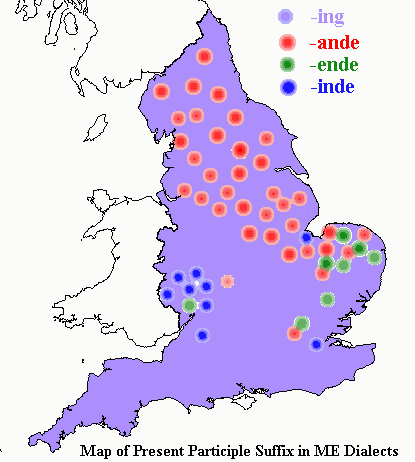
-ing はすでに England の全域に分布しており,方言特徴と呼ぶのはふさわしくないかもしれないが,その異形態として現われる -nd(e) 形の母音部分の差が方言をよく弁別する.-ande の分布は Northern から East Midlands にかけての地域(かつての Danelaw )に一致する.-ende は East Midlands ,-inde は South-West Midlands に集中する.ロンドン付近で複数の異形態が観察されるのは,その地がまさに諸方言の境であることを示している.
現在分詞語尾の他には,直説法3人称単数現在語尾と直説法複数現在語尾が,方言特徴をよく表わすものとして知られている.この2項目の分布は残念ながら直接 LALME の Dot Map には与えられていない.いきおい図式的ではあるが,Burrow and Turville-Petre (31--32) の記述を参考に,地図化してみた.
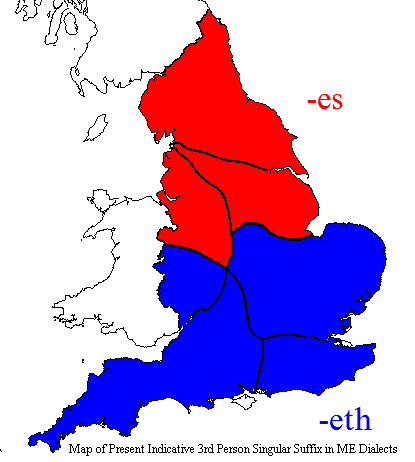
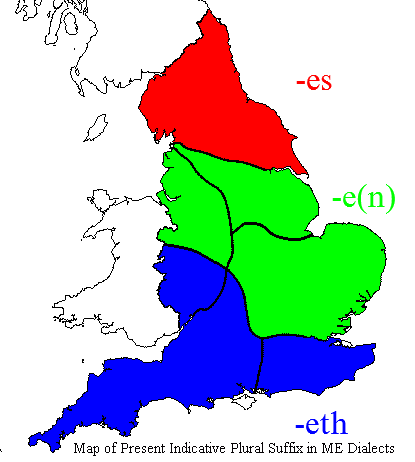
この3つの動詞屈折語尾に注目するだけでも,ある程度,中英語の方言の絞り込みができるだろう.
・ McIntosh, Angus, M. L. Samuels, and M. Benskin. A Linguistic Atlas of Late Mediaeval English. 4 vols. Aberdeen: Aberdeen UP, 1986.
・ Burrow, J. A. and Thorlac Turville-Petre, eds. A Book of Middle English. 3rd ed. Malden, MA: Blackwell, 2005.
Powered by WinChalow1.0rc4 based on chalow